

Running a solo business can feel like working in a vacuum, but the most successful solopreneurs aren't actually going it alone. They're plugging into small, focused online communities that accelerate their growth faster than any paid course or productivity hack ever could. The misconception that solo work equals isolation is one of the most damaging myths in the creator economy. The reality? The right community can compress years of trial and error into months, connect you with the exact collaborators you need, and give you the kind of honest feedback that friends and family simply won't.
Table of Contents
- Why online communities matter for solopreneurs
- Core elements of thriving online communities
- Choosing the right tech and human touch: tools vs. real connection
- Practical ways to initiate and nurture your community
- What most solopreneurs miss about online communities
- Take your solo business community to the next level
- Frequently asked questions
Key Takeaways
| Point | Details |
|---|---|
| Community drives growth | Purpose-driven online communities provide support, insight, and momentum for solopreneurs. |
| Start small, grow strong | Launching a focused, niche group and prioritizing onboarding leads to higher engagement. |
| Blend tech with humans | The right tools paired with regular interaction like mastermind sessions maximize value. |
| Avoid over-engineering | Simple systems and moderation work better than complex gamification. |
| PaidSolo enables action | Explore PaidSolo tools to build, nurture, and expand your solo business community. |
Why online communities matter for solopreneurs
The word "community" gets thrown around so loosely that it's easy to dismiss it as marketing fluff. But for solopreneurs, a well-structured online community is a genuine business asset. Think of it as a solopreneur support ecosystem that handles the things you can't do alone: accountability, peer feedback, warm referrals, and rapid problem-solving.
Here's why this matters more than most guides admit. When you're building a business by yourself, you don't have a team to pressure-test your ideas. You don't have a manager to flag when you're heading in the wrong direction. A strong community fills that gap in ways that are both practical and psychological.
Key reasons solopreneurs benefit from online communities:
- Peer learning: You learn faster from someone who solved your exact problem last month than from a generic YouTube tutorial.
- Mastermind dynamics: Small accountability groups push you to follow through on goals you'd otherwise quietly abandon.
- Faster problem-solving: A well-placed question in a focused community can get you a working answer in hours, not days.
- Warm referrals: Members refer each other to clients because trust already exists. Cold outreach doesn't come close to this conversion rate.
- Emotional resilience: Solo work is mentally taxing. Community reduces the isolation that leads to burnout.
One critical insight that most articles skip over: niche, purpose-driven communities consistently outperform broad, generic ones. A community of 200 freelance video editors will generate more value for each member than a group of 10,000 "entrepreneurs" who share nothing but a vague ambition.
"Launch small to build core. Slow growth is OK. The first 72 hours of onboarding are critical. Auto-welcomes, introductions, and simple AI moderation for spam set the tone for everything that follows." — Building an Online Community That Actually Thrives
If you're already exploring agency stack tools to streamline your operations, adding a community layer to your workflow is the logical next step. Tools alone don't build momentum. People do.
Core elements of thriving online communities
Understanding why communities matter is one thing. Knowing what makes them actually work is where most solopreneurs stumble. Let's break down the foundational pillars.

Tiered access vs. open access
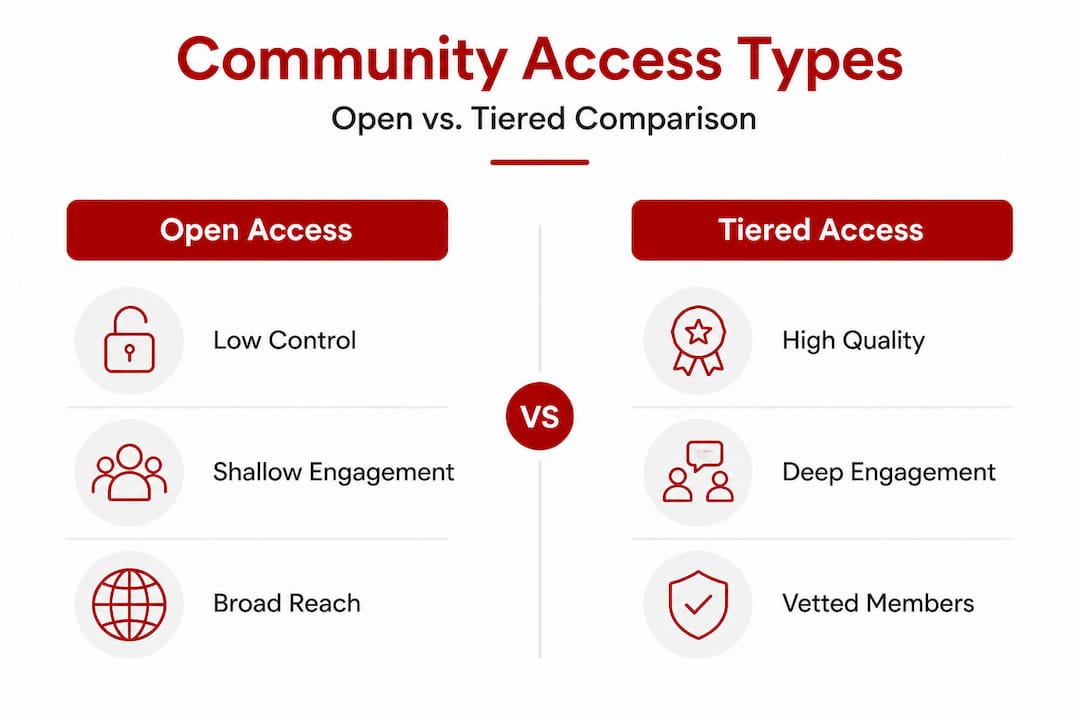
Not every community needs to be open to everyone. In fact, open-door policies often dilute the quality of conversation. Tiered access, where new members have limited permissions and earn their way into deeper discussions, keeps the signal-to-noise ratio high. Think of it like a private Slack channel inside a larger Discord server. The inner circle conversations are where the real value lives.
| Feature | Open access | Tiered access |
|---|---|---|
| Member quality control | Low | High |
| Engagement depth | Shallow | Deep |
| Spam risk | High | Low |
| Onboarding complexity | Simple | Moderate |
| Long-term retention | Variable | Stronger |
The first 72 hours: your most important window
According to community-building research, the first 72 hours after a member joins are the single most critical period for long-term retention. If someone joins and hears nothing, they'll never come back. Period.
Here's a practical onboarding sequence that works:
- Automated welcome message sent within minutes of joining. Keep it warm, not robotic.
- Introduction prompt asking new members to share one sentence about what they do and what they need.
- Pinned "start here" post that explains community norms, where to find resources, and how to get the most value.
- Personal outreach from the community founder or a designated ambassador within 48 hours.
- First engagement nudge inviting the new member to comment on an existing thread or answer a simple question.
This sequence transforms passive lurkers into active contributors. Skip it and you're leaving retention on the table.
Gamification: less is more
Points, badges, leaderboards. These sound exciting in theory. In practice, over-engineering gamification is one of the fastest ways to kill authentic engagement. When members focus on earning points instead of building relationships, the community loses its soul. Keep any gamification extremely light: a simple "welcome" badge for introductions, maybe a "top contributor" callout in a monthly newsletter. That's it.
Pro Tip: Before adding any gamification feature, ask yourself: "Does this encourage real conversation or just activity for activity's sake?" If you can't answer clearly, skip it.
The PaidSolo agency stack approach to community tools follows the same philosophy: use what genuinely adds value, cut everything else.
Choosing the right tech and human touch: tools vs. real connection
Once you understand the framework, you face a practical decision: which platform do you actually build on? And how do you prevent your community from becoming just another notification people ignore?
Platform comparison
The two platforms most recommended for solopreneur communities right now are Circle and Mighty Networks. Both are purpose-built for community, not social media. They're designed to keep conversations in one place rather than scattered across DMs, email threads, and Slack channels.
| Platform | Best for | Pricing tier | Key strength |
|---|---|---|---|
| Circle | Content creators, course builders | Mid-range | Clean UI, course integration |
| Mighty Networks | Niche communities, membership sites | Mid-to-high | Native courses + community |
| Discord | Tech-savvy, informal groups | Free/paid | Real-time chat, bots |
| Slack | Professional, work-style groups | Free/paid | Integrations, search |
As research on solopreneur ecosystems confirms, prioritizing niche, purpose-driven spaces over broad ones consistently drives higher engagement, and blending digital tools with human elements like masterminds and co-working sessions produces the best results.
Blending digital tools with human interaction
Here's the trap most solopreneurs fall into: they pick a platform, set it up beautifully, and then wait for magic to happen. It doesn't. Technology is the container. Human connection is the content.
The communities that retain members long-term all share one habit: regular scheduled human touchpoints. These don't have to be elaborate. Consider:
- Weekly async video check-ins where members post a 60-second update on their progress.
- Monthly live co-working sessions on Zoom where everyone works silently together for 90 minutes.
- Bi-weekly mastermind calls with 4 to 6 members who share similar business models.
- Rotating "hot seat" sessions where one member gets focused feedback from the group.
Pro Tip: The communities with the highest retention rates aren't the ones with the most features. They're the ones with the most consistent rhythms. Pick two or three recurring events and protect them like revenue-generating appointments.
The agency stack tools you use to run your business should support these rhythms, not complicate them. Automation handles the logistics so you can focus on the relationships.
Practical ways to initiate and nurture your community
Theory is useful. Action is better. Here's exactly how to start and sustain a community that actually delivers value.
Step-by-step: launching a focused community
- Define your niche ruthlessly. "Freelancers" is too broad. "Freelance UX designers who work with SaaS startups" is a community. The narrower your focus, the stronger the bond between members.
- Choose one platform and commit. Don't try to run a Discord, a Facebook group, and a Circle community simultaneously. Pick one and go deep.
- Recruit your founding 10 to 20 members manually. These are your core. Reach out personally to people you already know and respect. Don't launch publicly until this group is active.
- Create a simple onboarding sequence using the 5-step framework from the previous section.
- Set community norms early. What's allowed? What's not? What's the tone? Write it down and pin it prominently.
- Schedule your first live event before you have members. Announce it, then fill the seats. Urgency drives action.
Ongoing engagement routines that actually work
Consistency beats creativity every time. Here are weekly engagement habits that keep communities alive:
- Monday prompt: Post a single question every Monday morning. Something specific like "What's the one thing you're avoiding this week?" generates far more responses than "How's everyone doing?"
- Wednesday wins: A dedicated thread where members share small victories. This builds positive momentum and keeps people coming back.
- Friday resources: Share one tool, article, or insight that helped you that week. Invite members to do the same.
- Monthly spotlight: Feature one member's work or story. This creates social proof and makes members feel seen.
The one-person agency stack philosophy applies here too: keep your systems lean, repeatable, and human-centered. You don't need 20 engagement tactics. You need three that you actually do every week.
As community-building best practices consistently show, slow growth is genuinely OK. A community of 50 deeply engaged members will generate more value, more referrals, and more revenue than a community of 500 passive ones.
Pro Tip: Resist the urge to open your community to everyone just to inflate the member count. Quality engagement compounds. Passive members dilute it.
What most solopreneurs miss about online communities
Here's the uncomfortable truth that most community-building guides won't say out loud: the majority of solopreneurs who start communities fail not because they chose the wrong platform or wrote the wrong welcome message. They fail because they tried to scale before they had a core.
The instinct to grow fast is understandable. More members feels like more validation. But growth without a solid foundation just accelerates the decay. When your founding members don't feel special anymore because the community suddenly has 2,000 strangers in it, they leave. And when the early adopters leave, the energy collapses.
The first 72 hours of onboarding are not just a tactical detail. They're a philosophical statement about what your community values. A rushed, automated, impersonal welcome tells new members exactly what to expect: a community that doesn't actually care about them as individuals. That impression is almost impossible to reverse.
The gamification trap is equally destructive, and it's one I've watched kill otherwise promising communities. Founders add points systems because they read that engagement increased by X% on some platform. What they don't measure is the quality of that engagement. Members gaming a leaderboard are not building relationships. They're performing for an algorithm. That's the opposite of what a healthy community needs.
What actually works is boring by internet standards: show up consistently, ask good questions, celebrate members publicly, and protect the quality of the space with clear norms. The tools for solo agencies that support this kind of community are the ones that reduce friction without replacing human judgment.
The solopreneurs who build truly valuable communities treat them like long-term business assets, not growth hacks. They measure retention, not just signups. They track conversation depth, not just post volume. And they're willing to remove members who don't fit the culture, even if it means a smaller number on the dashboard.
Scale is a byproduct of quality. Chase quality first.
Take your solo business community to the next level
Building a community is one of the highest-leverage moves a solopreneur can make, but it works best when your broader business infrastructure supports it. If your tools are scattered, your workflows are manual, and your systems are held together with duct tape, managing a community on top of everything else becomes a burden instead of an asset.
At PaidSolo, we've tested and reviewed the tools that actually make this easier. From the agency stack tools that automate your operations to the Solo Business OS that keeps your entire business organized in one place, the goal is the same: free up your time and energy so you can focus on what only you can do. Building real relationships with real people in a community worth belonging to.
Frequently asked questions
What is the best platform for online communities as a solopreneur?
Platforms like Circle and Mighty Networks offer user-friendly interfaces and strong engagement tools specifically built for solo business owners, making them the top choices for niche community building over generic social platforms.
How do I keep my online community engaged long term?
Consistent rhythms matter more than features: focus on strong first 72-hour onboarding, regular mastermind sessions, and meaningful member introductions to build habits that sustain engagement over months and years.
Should I use AI moderation in my community?
AI moderation is effective for filtering spam and reducing your manual workload, but keep it simple since over-automating moderation can strip away the human feel that makes communities worth joining.
Why is slow growth recommended for new communities?
Launching small lets you build a tight-knit core group where relationships are genuine, norms are established, and engagement is deep before you open the doors wider and risk diluting what made the community valuable in the first place.